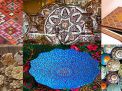
“The taste and talent of this people can be seen through the designs of their earthen wares”, R. Ghirshman
The history of the art of pottery in Iran goes back into ancient time. When agriculture came into existence and cultivation started on Iran’s plateau by primitive races of this land, people made utensils of baked clay in order to meet their needs.
Earthenware is actually one of the oldest handicrafts in the world. Among the most famous old pottery, pitchers and bowls can be named. Before glass manufacturing became widespread, most dishes used by humans were pottery. The best-performing soil for pottery is clay, which because of the large amounts of iron is red.
Iran can be called the birthplace of designed earthenware utensils. Designing earthenware in Iran started about 4,000 BC. In Iran pottery manufacture has a long and brilliant history. Due to the special geographical position of the country, being at the crossroads of ancient civilizations and on important caravan routes, almost every part of Iran was, at times, involved in pottery making.
Currently, pottery art is popular in traditional and industrial ways in Iran, and its main centers are Laljin, Hamedan; Meybod, Yazd; Shahvar, Minab; Mend, Gonabad and etc…
Ceramic and pottery
The first excavated ceramic objects belonging to 10 to 12 thousand years ago were explored in Zagros mountain range in Iran that indicate a long history. Archeological studies in Iran have shown that Iranian pottery has a history as old as 8,000 years. One of the most important characteristics of the pottery and ceramics in different regions of Iran is “the expressive and beautiful decorations” on them. These decorations in different parts of Iran are completely compatible with the people’s belief, culture and climate of those areas. The color and quality of Iranian tiles and ceramics are so unique that they have resisted hard climatic and erosive conditions of Iran for centuries. Lalejin in Hamedan is the hub in this field.
Laljin center of Persian pottery
Laljin is known as the Middle East pottery and ceramic center. 80 percent of the population of the city of Laljin is engaged in pottery and ceramic works. This city is one of the major centers of pottery and ceramics in Iran and the world. The products of the hard-working artists of this region, in addition to nearby cities of Iran, are exported to many other countries. Laljin’s pottery is very diverse and includes a variety of decorative and consumable dishes.
Although pottery is a very old industry, but with time and expanding urban life, this art has not only disappeared but also evolved and adapted itself to the needs of today’s life. Over time, humans have drawn more beautiful styles with different colors on these dishes, and its beauty has doubled.
Most of the pottery in this area is marketed without a single-glazed stone. The products of this area are very diverse and in terms of soil and glaze, are relatively better than other parts of Iran. The colors of the glazes made in Hamedan are often Azure, Blue, Navy blue, Salmon, Yellow, Green, Turquoise and Brown.
Embossed role tableau and small sculptures are among the most popular gifts in today’s world.