The shipping process covers the flow of goods and documents from the place of origin to the place of destination. For the process to be completed successfully, the transfer of goods and documents from one party to another must be highly synchronised.Bellow guide will help to ensure your goods are shipped properly and efficiently by explaining the shipping process step by step.
Step1: Importer requests quotes:
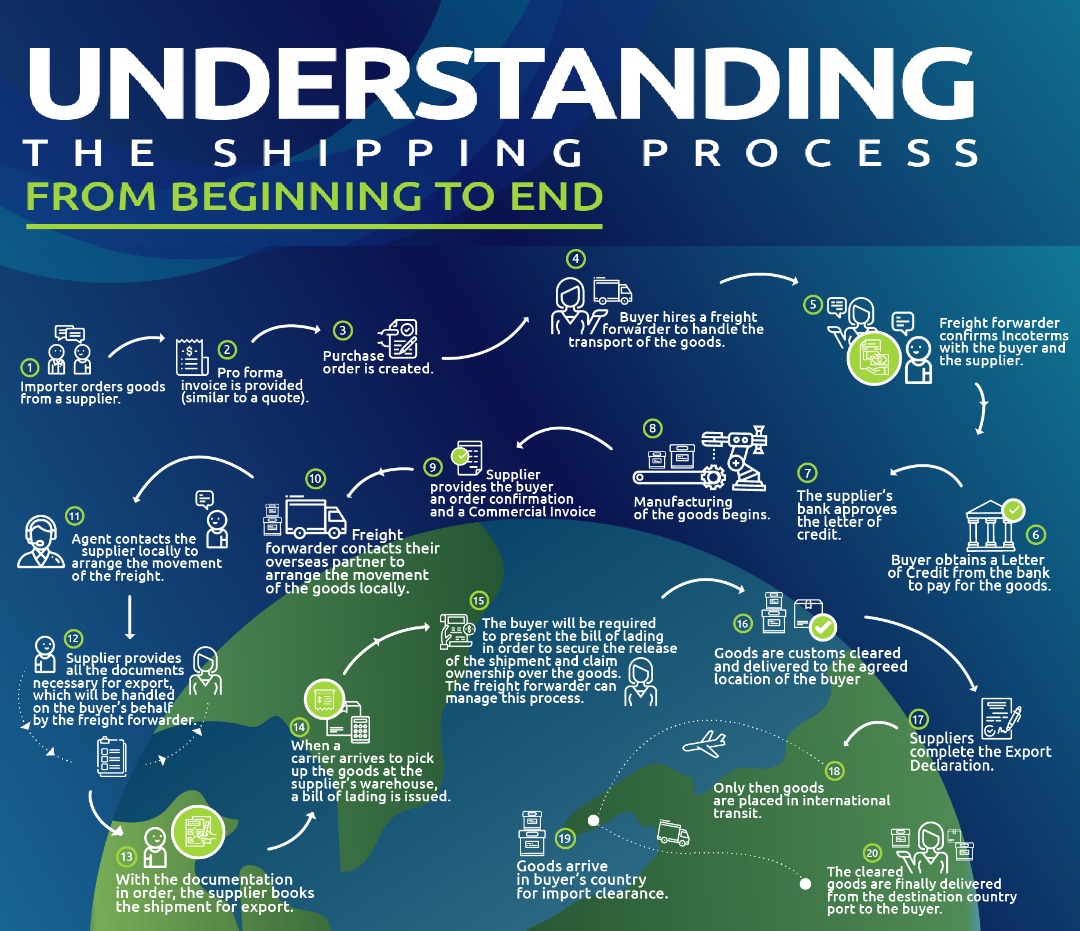
The first step in the shipping process is when an importer,also known as the consignee, orders goods from a supplier,also known as the consignor/Exporter.In a usual import, buyers will generally ask suppliers for a quotation when the goods purchase is intented.The quote can often be in the form of (proforma invoice). A proforma invoice is effectively an invoice that is used to provide an estimate and can be subject to change(a pre-document before the final invoice will be issued).This differs from a commercial invoice which is a final and official invoice used for c declarations.
Step2:Exporter issues a commercial invoice after getting confirmation of buyer on proforma invoice:
As the quote has been approved, the supplier will create a purchase order.A purchase order is simply a contract including details of the order and cost of the goods.Depending on the business, the purchase order will also contain projected shipping date, origin and destination addresses,package No & dimensions as well as the freight costs.
When a buyer issues a purchase order to a supplier, the contract should be by one of the many incoterms. As this one who do business with abroad countries should familiarise himself with the incoterms which were updated for 2020 (the last update).Incoterms are essentially the terms that share out the costs and the risks between the buyer and seller over shipping process.Essentially,they determine who is responsible for what while the goods are moving from Point A to Point B.It is important to select the set of Incoterms that are most appropriate for the transaction of your goods.The incoterms will also determine which party needs to hire a freight forwarder for the individual stages of the shipping process(internal shipping from supplier company to loading port or border + international shipping after the orging country border to final destination). For this process overview, we assume our importer has purchased the goods on EXW terms and will be responsible for all stages of the entire shipping.At this stage importer can arrange for a freight forwarder to manage the transportation of the goods from Point A to Point B.When an order is made, a common way to pay the supplier is payment by bank to suppliers account,which is considered pre-payment if it's not all amount of money.
Following this, the supplier will provide the importer with an official order confirmation named commercial invoice.This invoice is a key document, detailing the price and quantity of the sold goods. It will also contain the incoterm chosed before considered to be used.
Step3: Freight forwarder arranges export:
The overseas representative will in turn contact the relevant person(supplier company or consigner/Buyer) and arrange for the export of the buyer’s goods. This will involve the preparation of documents used in the customs declasration of goods on proper trading card, the documents used in the international shipping process which are required for customs and getting CO.(Certificate of origin)purposes.
Documents that need to be prepared by the supplier:
Packing List: a supplier will prepare a packing list which will be used by a freight forwarder for all the information regarding the freight being transported. It will include information such as the contact details of the exporter and the buyer,HS code,No & type of packing,Total Gross weigh,Total Net weight of shipping cargo.
Certificate of Origin: a supplier will also prepare this certificate if they are exporting goods by their trading card to destination country. This will be used to certify the location in which the goods were produced so that the buyer may benefit from local free trade agreements and avoid duty payments based on importer country rules.
shipper's Letter of Instruction(known as shipping order form): a supplier may be required to prepare an SLI, to provide the local shipping agent with a written record of the shipping information.
Manufacturer's custom Declaration: This is typically a declaration created by a manufacturer for customs purposes. It declares information such as whether or not the goods are toxic or hazardous and also declares what materials the goods contain also mentiones the hs code, tarrif percent and total value of the goods defined in customs system of the supplier country.
Dangerous Goods Forms: If a supplier is shipping dangerous goods as classified by the International Air Transport Association (IATA) or the International Maritime Organisation (IMO), they will be required to approve a DG form which includes relevant dangerous goods instruction and details as UN Numbers ,class and the proper packing type should be used.
Documents that need to be prepared by the buyer:
An Import Declaration: Importers may be required to fill out an import declaration. There are few types of declarations that can be requested depending on the circumstances and the customs entry.
A) Self-Assessed Clearance (SAC) Declaration: If a buyer’s goods arrive by sea or air and have a value of equal to or less than 5000 USD(for example), they’ll be required to fill out a SAC declaration.
B) Warehouse Declaration: In case a buyer intends to place their imported goods in a warehouse before clearing them from customs (and their value exceeds 5000 USD), they’ll require a Warehouse Declaration and the whole process for importing which means passing the duty,standards,certidicates of destination country.
Step4: Booking procedure:
Once the required documentation is in order, the shipping agent must make a booking for the export shipment.
Step5:Goods transport to international depot/port:
Once the goods are packed and ready they will be transported to a depot or port for export. Depending on the shipping incoterms, this will either be arranged by the supplier or by the consignee through their freight forwarder.
Step6:Freight Forwarder issues the bill of Lading:
When a carrier arrives to pick up the goods, a bill of lading is issued. A bill of lading confirms that the goods were received by the carrier in an acceptable condition.This is one of documents, which acts as legal proof of exporting goods.
The supplier will should provide the bill of lading to the consignee (buyer). The buyer will be required to present both the bill of lading and delivery order in order to the release of the shipment and claim ownership over the goods.