Cargo refers to goods carried by a large vehicle, like a plane, ship, train, or truck,which we name carrying cargo. Cargo word originates and routes from the Latin word carricare which means to load on a cart, or wagon. Cargo can be loaded on a cart(wagon), but it's usually loaded on something much bigger such as containers or vessles.
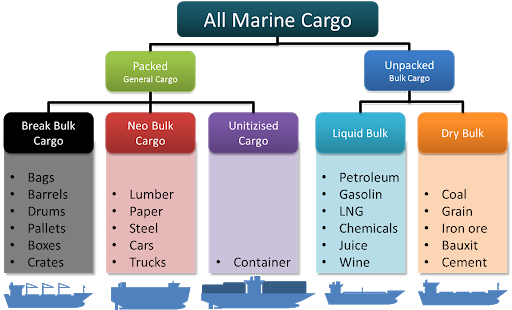
The cargoes carried by maritime transportation come into several categories by their type and each requiring the usage of specialized ships,which will be mentioned later in this context. The two main categories of cargoes are general cargo and bulk cargo. General cargo is unitized which means carried in defined load units,such as containers, while bulk cargo is loose cargo and it's carried in any quantity(Bulk cargo does not have a special packing type). General cargo can be sub divided into three categories:
Break Bulk: Break bulk cargo or general cargo are goods that must be loaded individually, and not in intermodal containers nor in bulk as with oil or grain. Ships that carry this sort of cargo are called general cargo ships. The term break bulk derives from the phrase breaking bulk,the extraction of a portion of the cargo of a ship or the beginning of the unloading process from the ship's holds. These goods may not be in shipping containers. Break bulk cargo is transported in bags, boxes, crates, drums, or barrels.
Neo Bulk:Neo bulk cargo includes cargoes that are prepackaged, accountable, transported in defined load units and not stored in a container. The ships to carry neo bulk cargo is designed for a specific cargo. Some examples are roll-on/roll-off(Ro-Ro) car-carrying ships and log-carriers ships. Generally, all of them are called neo bulk carriers.
Containerized: The growth of container shipping required creating a new general cargo category where the cargo is being carried in container load units. A container ship is a cargo ship that carries all of its load in truck size intermodal containers, in a technique called containerization. Container ships are a common means of commercial intermodal freight transport and nowadays carry most seagoing non-bulk cargo.
Container ship capacity is measured in twenty-foot equivalent units (TEU).Typical loads are a mix of 20-foot and 40-foot ((equals:2 TEU) ISO-standard containers)
Today about ninty percent of non-bulk cargo worldwide is transported by container ships, and the largest modern container ships can carry over 23,000 TEU which is a huge quantity of containers.